
Understanding Comics – and much much more
by sarah
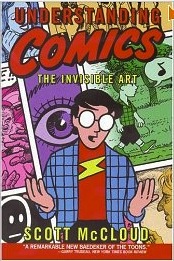 I just finished reading Understanding Comics, by Scott McCloud, and it was amazing. I’d read it once before, as an assignment in a Sound Design class in college (yes, sound design – taught by an insightful professor who focused as much on teaching us how to think about the world as he did on XLR cable and decibel levels). I remember liking the book, but at the time I was so busy with classes and homework and stage managing and trying to find time to sleep, I don’t think the full impact really had the chance to sink in before I moved on to the next reading assignment. This time was different.
On the surface, Understanding Comics is about the theory and structure behind how comics are put together. A comic-book version of Scott McCloud takes you through what comics are and a little bit about their history, and then delves into different comic styles and conventions, the interplay of words and pictures, and how all of those things affect how the reader perceives what they’re reading. It’s pretty fascinating stuff – I particularly like his discussion of why we identify more with cartoony, abstractly-drawn characters than with those drawn more realistically. (In a nutshell, we have a more complex picture in our minds of the people around us than we do of ourselves, so we associate simpler, more abstract drawings with our sense of self. It’s more complicated than that, but you’ll have to read it yourself to find out the rest!)
Underneath the comics-specific discussion, though, Scott has a lot of insight into the bigger picture – how we relate to art in general, what art is, and what it takes to create something – whether you call it “art” or not. Scott’s theory is that the creation of anything, in any medium, always follows the same six-step path:
- we start with an idea or purpose (1),
- choose what form/medium it will take (2),
- choose an idiom/language/style to create it in (3),
- figure out the structure of the thing we’re creating (4),
- use our craft to actually create it (5),
- and do the polishing/surface finishing of the final product (6).
An interest in any of these six steps might be the thing that draws us into a particular medium (a fascination with the craft of letterpress did it for me), but once we’ve found our basic direction, we all take pretty much the same path as we delve deeper and learn more about our art. Interestingly, though, the path we take actually starts at the end, with perfecting the surface appearance of the thing we’re creating, and slowly works its way backwards into the deeper worlds of style, form and ideas.
 I started learning letterpress printing about six months ago, and I’ve gotten pretty good at the surface polish – someone who isn’t trained in letterpress can look at my prints and see quality work that appeals to them, but I know there’s plenty of room to improve. I’m only just beginning to dive into the craft of letterpress – I’m starting to learn the nuances of keeping the impression even, I’m figuring out how to get the registration just right, and I’ve got a long way to go before I’m any good at color-matching. That’s part of what drew me to printing in the first place – I love a challenge, and I know I can keep working on my craft forever, and there will always be more to learn. Even as I work on my skills, though (step 5), I can see myself heading back along Scott’s path – I’m already thinking about other formats (step 4) that I want to try out (check out my very first limited edition art print – never done that before!), and wondering what other styles (step 3) I could incorporate into my work. Venturing into other big-picture ideas and media is a long way off, but I can see it far ahead of me, and it’s amazingly energizing to have some idea of where this path is taking me. It’s not a very concrete idea, but it doesn’t have to be – it’s just a sort of sense of direction that resonates with me and gives me a vague idea of where I’m headed.
I was really impressed at how cleanly my leap into letterpress – and other creative endeavors I’ve thrown myself into in the past – fit into Scott’s six-step path. I’d be curious to see what other people think, how their experiences compare to his theories, and whether they feel like they’ve followed the same path in their creative adventures.
What do you think? Does this resonate with you? Leave a comment below and tell us about it! And definitely check out the book – it’s a must-read for anyone interested in art, storytelling, creativity – and, of course, comics.