
A Little Pittsburgh History: The Smithfield Street Bridge
by sarah
Everyone knows that Pittsburgh is a city of bridges (The City of Bridges, in fact – we’ve got Venice beat by three!). Depending on how you count, we have 446 (counting towards the official record: only bridges that have piers, and are within the city limits), 994 (highway bridges in the metropolitan area), or 2139 (in all of Allegheny County, including all highway, pedestrian and railroad bridges over 8 feet long). If you go with the biggest number (’cause why wouldn’t you? we’re proud of our bridges!), that’s just about one bridge for every 500 people in Allegheny County. That’s a little mind-boggling.
 What a lot of people don’t know is that many of our bridges are actually the second, third, or even fourth incarnation to cross the river (or ravine or railroad tracks) at the same site. Take our beloved Roberto Clemente bridge, for example – did you know that the Clemente is actually the fourth bridge to cross the Allegheny River at Sixth Street? The first incarnation of the Sixth Street Bridge was a covered wooden bridge, constructed in 1819. That bridge was replaced in 1860 by a suspension bridge designed by John A. Roebling, which was in turn replaced by a Theodore Cooper truss bridge in 1893. In 1927, to make way for construction of the Three Sisters, Cooper’s truss bridge was lifted off its piers, put on barges, and floated downriver to become the Coraopolis-Neville Island Bridge. Amazing.
The 20’s and 30’s were actually the Golden Age of bridge-building in Pittsburgh – a combination of a US War Department river clearance requirement and the county’s plan for an Ultimate Highway System led to a lot of bridge construction during the Roarin’ Twenties. In fact, most of our oldest bridges were built during this Golden Age, which is part of why the Smithfield Street Bridge is so amazing: it opened almost 40 years before the Golden Age, and it’s still in use today.
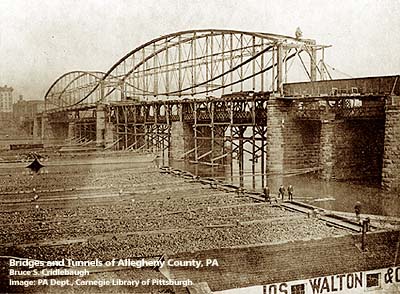 The first Smithfield Street Bridge, a covered wooden bridge that opened in 1818, was actually the first river crossing built in Pittsburgh. Can you imagine that? The first bridge to cross the Monongahela. The first road into what would become downtown Pittsburgh. That’s some pretty amazing history right there. That bridge was destroyed in the Great Fire of 1845 and replaced with one of Roebling’s wire rope suspension bridges (one of his first, in fact), but by 1880, traffic had become too heavy, and that bridge needed to be replaced. The current structure was designed by Gustav Lindenthal, who later designed the Hell Gate Bridge in New York City, and the new Smithfield Street Bridge opened in 1883. It is currently the oldest steel bridge in operation in the United States, and the oldest and longest through-truss bridge of its kind.
The bridge has gone through a few changes in the 127 years since it opened: it’s needed to be widened twice, in 1889 and 1911; the original cast-iron portals were replaced with the current steel design; and tracks that were originally built for horse-drawn streetcars were converted to electric streetcar lines, and then finally removed completely in 1985. The bridge was almost demolished in the early 90’s, but lobbying from the Pittsburgh History and Landmarks Foundation convinced the city to restore it instead; the refurbished bridge was finished in 1995, complete with the original three paint colors specified by Lindenthal and the six copper finials that top the portals at either end.
 For a lot of Pittsburghers, though, it’s not the bridge’s history that makes it so special – it’s the more recent past and the memories it holds for us. I remember going to the Grand Concourse for brunch with my family on birthdays and holidays, and watching the boats going under the bridge as we ate. I have friends who walk across the bridge to work every day, and others who grew up riding the streetcar across to go Christmas shopping “in the city” every December (they always met up at the Kaufmann’s Clock too, but we’ll save that story for another post!).
Do you have any stories, memories, or little-known-facts about the Smithfield Street Bridge? If you do, share them in the comments below! And if you’re interested in learning more about the bridge’s history, here’s a few great links to check out:
- The Smithfield Street Bridge and Pittsburgh’s bridges on Wikipedia
- The bridge’s stats and its historic record at pghbridges.com
- Photos on Flickr
Happy reading!
[…] This post was mentioned on Twitter by Sarah Deutsch. Sarah Deutsch said: A little local history lesson, for all you Pittsburgh history buffs! The Smithfield Street Bridge: http://bit.ly/cdSuEA […]