A Little Typography Cheat Sheet
by sarah
Type: The Secret History of Letters
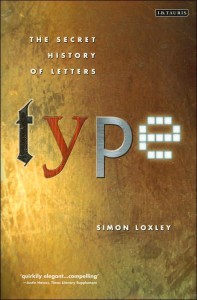 I picked up this book at the local library because I’ve always been really interested in typography, but I know virtually nothing about it. I started to teach myself calligraphy a few years back, so I know the anatomy of a letter. I have a bunch of fonts on my computer, which I generally choose by gut instinct more than any real understanding of design principles. I just love letters, and now that I’m doing a little bit of typography for the cards I’m printing, I want to learn more about them. And where better to start than with the history of type?
I chose this book mostly because it was the more interesting-looking of the two typography books our local library branch has, but it turned out to be perfect. It starts with the creation of Gutenberg’s first moveable type and sort of winds its way through history to the present, with brief interludes here and there to talk about things like type museums, foundries and specifics of the type cutting and casting trades. The whole book is written in a fascinatingly casual style – sort of like you’ve just sat down to chat with someone who knows all there is to know about the history of type.
I actually finished the book over a month ago, and I kept meaning to post something about it, but I kept forgetting. Unfortunately, I’m one of those people who reads something really fascinating and then can’t remember anything she read three days later. Fortunately, I know this about myself, and being the geek I am, I take notes. So here, without further ado, is the cheat-sheet I made for myself, to remember which typefaces are which, where they came from, and some random other useful and interesting information (common uses supplied by wikipedia, to help jog my memory):
Blackletter:
- Gutenberg’s first typeface
- gothic-looking
- hard to read
- official typeface of Nazi Germany
Caslon:
- one of the first English typefaces
- based on existing Dutch styles
- bracketed serifs
- some modulation of stroke
- short ascenders & descenders
Garamond:
- inspired by Roman type
- very readable in print
- bracketed serifs
- long ascenders & descenders
- used by Richelieu in French Royal Printing Office
- used in US editions of almost all Dr. Seuss and Harry Potter books
Baskerville:
- English typeface
- thin strokes become thinner
- bracketed serifs, sharper and more tapered
- nothing whatsoever to do with Sherlock Holmes
Bodoni:
- good example of a Modern typeface
- Italian
- more vertical
- thin strokes very thin
- flat, unbracketed serifs
- heavily influenced by Baskerville
- used in the logo for Carnegie Mellon University (my alma mater!)
Clarendon:
- English
- thick, bracketed serifs
- commonly used on Wanted posters in the Old West
Egyptian:
- slab-serif (thick, heavy serifs, no brackets)
- monoline (uniform stroke width)
- square ends
- developed for sign-writing
- good for short, bold copy, not ease of continuous reading
- exception: Caslon’s Egyptian was the first sans-serif!
So, there you have it. Not by any means a complete guide to typefaces, but it jogs my memory and helps me remember the key characteristics of a few of the big ones. Feel free to add your own useful type tidbits in the comments – I’ll take all the help I can get!
Edit: Thanks to @jessicahische, I just read this great article on the history of slab-serifs at H&FJ. I’ll keep adding more type history links here, as I come across them, so stay tuned!